
If you sell portable power stations under your own brand, or buy them in volume for wholesale, your supplier affects product safety, return rates, launch dates and customs clearance. This article lists what to check when you compare manufacturers in China, and the questions to ask before a first order.
1. Manufacturer or trading company?
Many suppliers on B2B platforms are trading companies. A trader can resell a product, but cannot change a circuit board, adjust firmware or fix a design fault. For OEM or ODM work, you need the company that designs and builds the product.
Ask for the factory address and a video call or visit to the production line. Ask which parts they design themselves (enclosure, BMS, inverter, firmware, app) and who makes the rest.
2. In-house BMS and inverter
The cells, the battery management system (BMS) and the inverter decide how a portable power station performs. The BMS protects the cells against overcharge, over-discharge, over-current, short circuit and extreme temperatures. The inverter sets the real continuous output and surge capacity.
A supplier that develops its own BMS and inverter can explain its test results, adjust parameters for your market and trace faults from the field. A supplier that buys a finished board from a third party often cannot.
3. Battery cells
Most portable power stations now use LiFePO4 (lithium iron phosphate) cells for their cycle life and thermal stability. Ask:
- Which cell brand and grade are used?
- Are the cells in mass production the same as in the samples?
- What is the rated cycle life, and at what depth of discharge (DoD)? Only compare cycle numbers measured under the same conditions.
4. Certifications for your market
Missing certificates are a common cause of delayed shipments and blocked listings. Typical requirements:
- EU: CE
- US: FCC; UL 2743 for portable power packs
- UK: UKCA
- Japan: PSE
- Battery shipping: UN38.3 test report and MSDS
Ask for certificates and test reports for the exact model you are buying. Check the model number and company name on each document. If your market needs a certificate the supplier does not have yet, ask whether they can obtain it and who pays.
5. Specifications your customers check
- Capacity (Wh) and continuous AC output (W): also check the surge rating if customers will run motors or compressors.
- Charging: AC charging time, maximum solar input, and whether an external adapter is needed.
- Socket versions: US, EU, UK, JP and AU outlets differ. Confirm there is a version for each market you sell in.
- UPS switchover time: important if customers use the unit as backup for computers or network equipment.
- App: remote monitoring and over-the-air (OTA) firmware updates.
6. OEM and ODM terms
Agree on these points before you start:
- MOQ for OEM (your brand on an existing model) and for ODM (changes to design or function)
- Lead time for samples and for mass production
- Who owns tooling and design changes
- Who handles certification under your brand name
7. Warranty and after-sales
Ask how long the warranty is, what it covers, and how failed units are handled: spare parts, replacement units or repair. Overseas warehouse stock shortens delivery and replacement times.
8. Shipping
Lithium batteries are dangerous goods in transport. An experienced supplier has UN38.3 and MSDS documents ready and works with forwarders that handle battery cargo by sea, air and express.
Questions to send a supplier
- Is this your own factory? Can we see the production line?
- Which parts do you design in-house?
- Which cell brand and grade do you use?
- Can you send the certificates for this exact model?
- What is the MOQ for OEM and for ODM?
- How long is the warranty, and how are failed units handled?
- Which shipping methods do you support? Do you have overseas warehouses?
About NIUESS
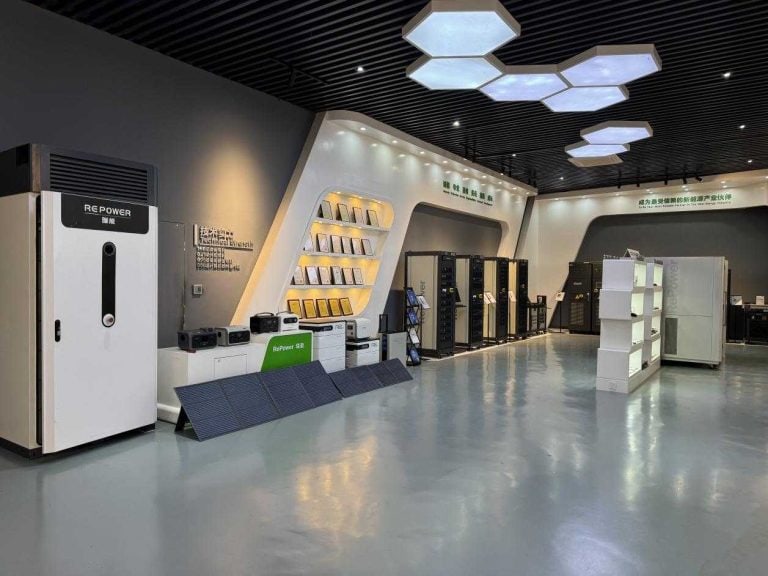
NIUESS is the portable power station brand of Shenzhen RePower Times Technology Co., Ltd. (“RePower Times”), based in Guangming District, Shenzhen. Our parent company, RePower, was founded in 2003 and specializes in battery testing equipment. The group has more than 1,200 employees, 40% of them in R&D, and more than 25,000 m² of office and production area.
Our answers to the questions above:
- Factory and R&D: we are a manufacturer. Except the battery cells, product ID design, solution R&D and inverters are done by our own team, and our products use a built-in intelligent BMS.
- Cells: A-grade LiFePO4 cells from first-tier brands.
- Certifications: most of our products have CE, FCC, UKCA and PSE. For battery shipping we have MSDS, UN38.3 and UL 2743. Other certifications can be made to customer requirements.
- Features: X-Turbo (2x overdrive start-up), X-Charge (no adapter needed, fully charged within 80 minutes), 20 ms UPS switchover, and app remote control with OTA updates.
- OEM and ODM: available, with an MOQ.
- Warranty: 2 to 5 years, depending on the product.
- Shipping: air, sea, express or door-to-door pickup through long-term freight forwarders. We also have overseas warehouses.
- Markets: Europe, North America, Southeast Asia and the Middle East.
Current models:
- NE-700 – 512Wh
- NE-700Pro – 720Wh
- NE-1200 – 1228Wh
- NE-2400 – 2304Wh
- NE-5000B – 5kWh mobile energy storage trolley
See all portable power stations, or contact us with your target market, quantity and requirements.