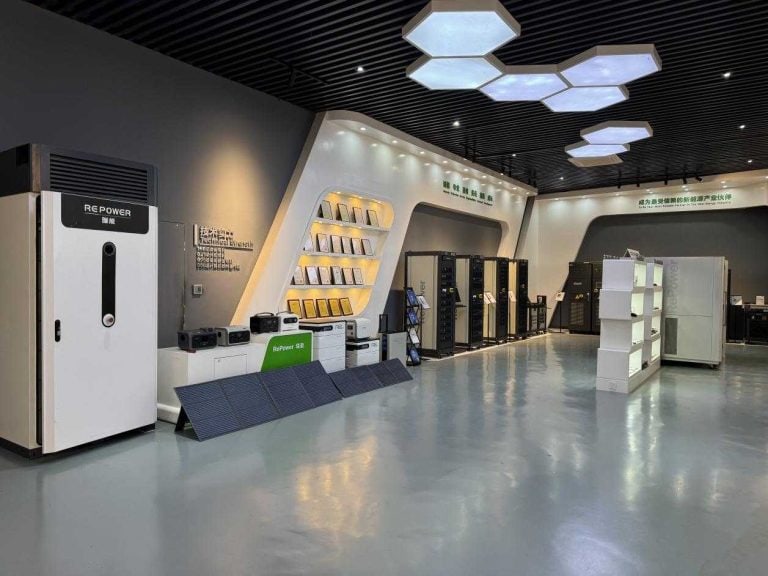

Residential battery storage lets a home keep electricity for later instead of using it the moment it is generated or bought. Paired with rooftop solar, it turns daytime sunshine into evening power, keeps the lights on during outages, and cuts the amount of expensive peak-hour electricity a household buys from the grid.
This guide brings together everything homeowners, installers and distributors usually ask: what a home battery system is, how it works, which battery types exist, the difference between grid-tied, hybrid and off-grid setups, how to size a system, and what to check before buying.
What Is Residential Battery Storage?
Residential battery storage (also called a home battery, home energy storage system or home ESS) is a battery system installed in a house to store electrical energy and release it when needed. The energy can come from solar panels, a small wind turbine, or the grid itself during cheap off-peak hours.
A typical system includes:
- Battery modules – today almost always lithium iron phosphate (LiFePO4), which store the energy.
- Battery management system (BMS) – monitors cell voltage, current and temperature and protects the battery.
- Inverter – converts the battery’s DC power to AC for household appliances. A hybrid inverter also manages solar input and the grid connection.
- Energy management system (EMS) / app – decides when to charge, discharge, export or import, and lets the owner monitor everything.
How Does a Home Battery System Work?
Solar panels produce the most electricity around midday, while most households use the most electricity in the morning and evening. Without storage, surplus solar power is exported to the grid—often for a low feed-in tariff—and the home buys power back later at a higher price.
With a battery, the daily cycle looks like this:
- Daytime: solar panels power the home first; the surplus charges the battery.
- Evening and night: the battery discharges to run lights, appliances and electronics.
- Off-peak hours: where time-of-use tariffs apply, the system can top up the battery from the grid when electricity is cheapest.
- Power outage: the system switches to backup mode and keeps essential loads running.
The EMS handles these decisions automatically based on solar production, battery state of charge, household load and electricity prices.
Key Benefits of Residential Battery Storage
1. Higher solar self-consumption
Storing surplus solar energy instead of exporting it means a much larger share of the solar power is used in the home. As feed-in tariffs fall in many markets, self-consumption is now the main economic driver for home batteries.
2. Lower electricity bills through peak shaving
Under time-of-use pricing, a battery charges when electricity is cheap and discharges during peak hours, so the household avoids buying grid power at the highest rates.
3. Backup power during outages
A grid-tied solar system without storage must shut down during a blackout to protect utility workers from backfeed. A home battery with backup capability keeps the refrigerator, lighting, internet, medical devices or a well pump running—valuable in regions exposed to storms, wildfires or an unstable grid.
4. Energy independence
Combined with enough solar capacity, a battery can cover most of a home’s daily needs, reducing exposure to rising energy prices. In remote locations, it can make the home fully independent of the grid.
5. Lower carbon footprint
Using more of your own solar energy and less fossil-fuel grid power reduces household CO₂ emissions.
6. Grid services and incentives
In some regions, home batteries can join virtual power plant (VPP) programs or receive subsidies, tax credits or rebates, which improves the return on investment.
Types of Batteries Used for Home Energy Storage
- Lithium iron phosphate (LiFePO4 / LFP): the current standard for home storage. LFP offers long cycle life (typically 3,000–6,000 cycles), high thermal stability and no cobalt. All NIUESS home batteries use LFP cells.
- Lithium NMC: higher energy density, so more compact, but shorter cycle life and lower thermal stability than LFP. Now less common in new home systems.
- Lead-acid: low upfront cost, but heavy, limited depth of discharge and short lifespan. Mostly found in older or very low-budget off-grid systems.
- Flow batteries: very long life and easy capacity scaling, but large, expensive and rarely practical for a single home.
Grid-Tied, Hybrid and Off-Grid Systems
Grid-tied with storage (AC-coupled)
The battery has its own inverter and connects on the AC side, next to an existing solar inverter. This is the easiest way to add storage to a home that already has solar.
Hybrid (on/off-grid) systems
A hybrid inverter connects solar panels, battery and grid in one unit. It runs grid-connected most of the time, optimizing self-consumption and tariffs, and switches to off-grid backup mode when the grid fails. Most new residential installations use this design.
Off-grid systems
Off-grid homes have no utility connection. Solar panels, a battery bank and often a backup generator supply all electricity. These systems need more battery capacity and careful design so the home has power through cloudy days and winter months. They are common for remote houses, farms, cabins and areas with weak grid infrastructure.
All-in-One vs. Stackable Home Batteries
All-in-one systems combine the battery, inverter and BMS in a single cabinet. Installation is quick and the look is clean—well suited to standard homes with predictable needs.
Stackable (modular) systems let installers add battery modules and inverters as needed. The same product line can serve a small apartment or a large house, and owners can expand capacity later.
How to Size a Residential Battery System
- Daily energy use (kWh): check electricity bills. Many homes use 10–30 kWh per day.
- Goal: backup only, bill savings, or near-full independence. Backup for essential loads needs far less capacity than whole-home independence.
- Peak power (kW): add up the appliances that may run at the same time—air conditioners, pumps, ovens and EV chargers have high power and surge requirements. The inverter must handle these loads.
- Solar array size: the battery should be large enough to store typical daily surplus, but there is little value in a battery the solar array can never fill.
- Room to expand: a modular system lets you start smaller and add capacity later, for example after buying an EV.
As a rough rule, a 5 kWh battery covers essential evening loads for a small household; 10–15 kWh suits most family homes; 20–30 kWh or more is typical for large homes, high-consumption households or off-grid living.
What to Check Before Buying
- Cell chemistry and cycle life: LFP with a stated cycle life at a defined depth of discharge.
- Usable capacity: not just nominal capacity—check the depth of discharge.
- Inverter compatibility: if you use a third-party hybrid inverter, confirm the battery’s BMS communication protocol is supported.
- Backup switchover time: how quickly the system takes over during an outage (UPS-level switching is measured in milliseconds).
- Certifications: required certifications differ by market. Ask the supplier for the actual test reports and certificates for your country.
- Warranty: length in years and guaranteed remaining capacity at the end of the warranty.
- Local regulations: permits, grid-connection approval and installation rules vary by country and utility. Work with a qualified local installer.
NIUESS Residential Energy Storage Products
NIUESS is the portable power and home energy storage brand of Shenzhen RePower Times Technology Co., Ltd. (“RePower Times”). Our parent company, RePower, has developed battery testing equipment since 2003. Our home storage products use A-grade LiFePO4 cells from first-tier brands, with our own BMS and inverter design:
- NE-5600 Stackable Home Battery System – modular LiFePO4 battery with built-in inverter, 5.12–30.72 kWh, parallel support for larger homes.
- RESS-5000A All-in-One Home Battery – 5 kWh LiFePO4 all-in-one unit for compact installations.
- RESS-10000A All-in-One Home Battery – 10 kWh LiFePO4 all-in-one unit for typical family homes.
We offer OEM and ODM service (MOQ applies) and supply bulk orders. See all residential energy storage systems, or contact us for specifications and pricing.
FAQ
How long does a home battery last?
A quality LFP home battery typically lasts 10–15 years, or several thousand charge cycles, depending on usage, depth of discharge and operating temperature.
Can I add a battery to my existing solar system?
Yes. You can add an AC-coupled battery with its own inverter, or replace the existing inverter with a hybrid inverter and connect a compatible battery.
Can a home battery work without solar panels?
Yes. A battery can charge from the grid during off-peak hours and discharge during peak hours, or simply serve as backup power. Solar panels make the system much more economical.
Will a home battery power my whole house during an outage?
It depends on battery capacity, inverter power and how the backup circuit is wired. Many homes back up essential loads only; whole-home backup needs a larger inverter and more capacity.
Is LiFePO4 safe for indoor installation?
LFP is the most thermally stable lithium chemistry used in home storage. Always follow the manufacturer’s installation manual and local codes for location, ventilation and clearances.